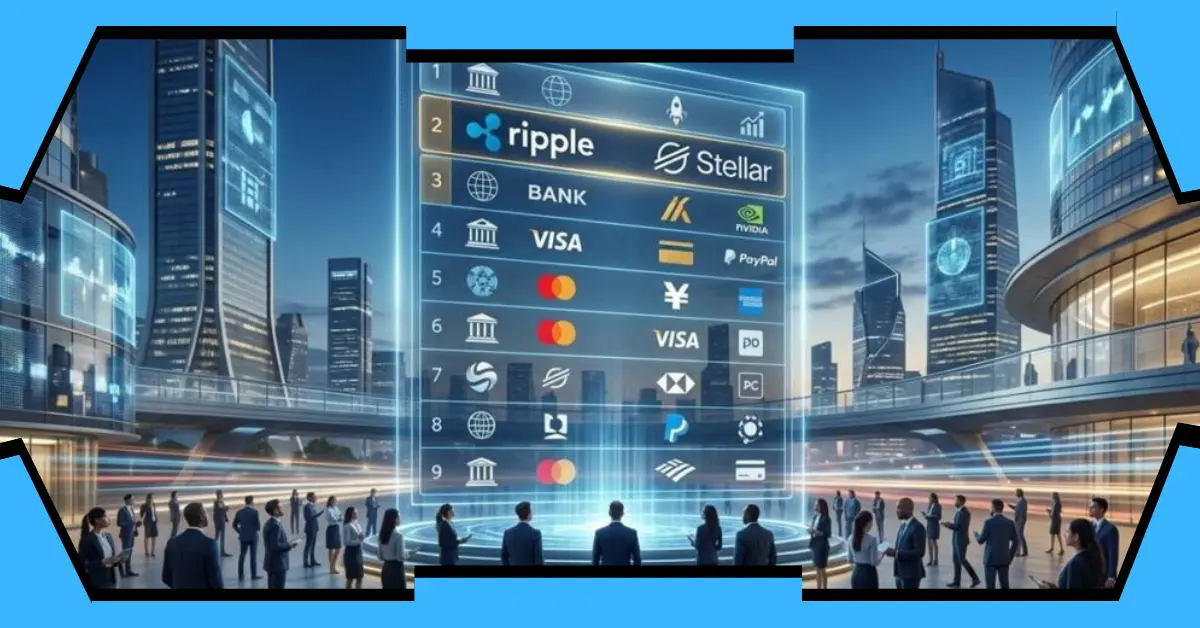
The global payments industry is changing quickly. Blockchain networks are now part of mainstream finance. Traditional banks and fintech firms are also adapting. In the latest FXC Intelligence 2026 ranking, this shift is clearly visible. Visa, PayPal, and Barclays appear alongside blockchain companies. As a result, the list shows how finance is evolving. This marks an important moment for Ripple and Stellar in FXC Top 100.
FXC 2026 Top 100 Shows a New Direction in Payments
The FXC Intelligence Top 100 Cross-Border Payments Companies list is a key industry benchmark. It does not focus only on crypto. Instead, it evaluates real payment use cases and global reach.
Moreover, the inclusion of Ripple and Stellar shows growing trust in blockchain systems. These networks now sit beside major institutions like SWIFT, Bank of America, and Deutsche Bank.
Therefore, Ripple and Stellar in FXC Top 100 highlights a clear trend. Blockchain is no longer experimental. Instead, it is becoming part of real financial infrastructure.
In addition, this shift shows that payment systems are merging. Traditional finance and blockchain are now working closer together.
Why Ripple and Stellar Matter in Global Payments
Ripple and Stellar have different goals. However, both aim to improve cross-border payments.
Ripple focuses on banks and large financial institutions. It helps reduce settlement time. It also improves liquidity between currencies. As a result, banks can move money faster and with fewer intermediaries.
On the other hand, Stellar focuses on financial access. It supports low-cost transfers. It is often used in emerging markets. In these regions, traditional banking is limited.
Because of these differences, Ripple and Stellar in FXC Top 100 shows balance. One targets institutions. The other supports everyday users. Together, they represent two sides of the same system.
Moreover, both are now treated as serious infrastructure players.
Institutional Adoption Is Driving Change
Big companies are now using blockchain technology more often. For example, PayPal has expanded crypto services in select regions. Users can now hold and transfer digital assets.
Similarly, Visa has tested blockchain settlement systems. These systems aim to reduce payment delays. In addition, they improve transparency.
Banks are also exploring blockchain tools. Barclays and Standard Chartered are testing distributed ledger solutions. These tests focus on faster settlement and lower costs.
As a result, Ripple and Stellar in FXC Top 100 reflects real adoption. It is not just theory. It is based on active use in global finance.
How Ripple and Stellar Fit in the Bigger Ecosystem
The payments industry now includes many players. Crypto exchanges and fintech firms are part of the system. For example, Coinbase, Binance, and Circle play major roles.
Moreover, Ripple and Stellar support different layers of this ecosystem. Ripple works with banks and liquidity providers. Stellar focuses on remittances and inclusion.
Therefore, Ripple and Stellar in FXC Top 100 shows how the system is becoming more connected. Blockchain networks are no longer separate. Instead, they are part of the same financial structure.
In addition, FXC Intelligence helps track this change. FXC Intelligence collects data on global payment flows. Its ranking includes both traditional and digital firms. As a result, it gives a full picture of the industry.
Real-World Use Cases Supporting Growth
Cross-border payments are still slow in many cases. They are also expensive. However, blockchain is helping to improve this.
For example, remittances are one major use case. Workers sending money home can use blockchain networks. This reduces fees. It also speeds up transfers.
In addition, institutions benefit from faster settlement. Banks can move funds without waiting days. Instead, transactions can settle in near real time.
Emerging markets also benefit. People with limited banking access can still send and receive money.
Therefore, Ripple and Stellar in FXC Top 100 reflects real-world demand. It is not only about technology. It is about solving real financial problems.
What This Means for the Future of Payments
The payments industry is moving toward integration. Traditional systems and blockchain systems are merging. However, this change will take time.
Stablecoins and tokenized assets are also growing. These tools may improve global transfers further. In addition, regulations are becoming clearer in many regions.
As a result, companies must adapt. Banks, fintech firms, and blockchain networks will work together more often.
Ultimately, Ripple and Stellar in FXC Top 100 shows where the industry is heading. It points to a future where multiple systems work side by side.
Conclusion
The FXC 2026 ranking shows a major shift in global finance. Blockchain networks are now part of mainstream payment infrastructure. They are no longer outside the system.
Moreover, Ripple and Stellar now stand alongside giants like Visa, PayPal, and Barclays.
In conclusion, Ripple and Stellar in FXC Top 100 signals a new era. Payments are becoming faster, more digital, and more connected. Traditional finance and blockchain are now building the future together
Leave a Reply