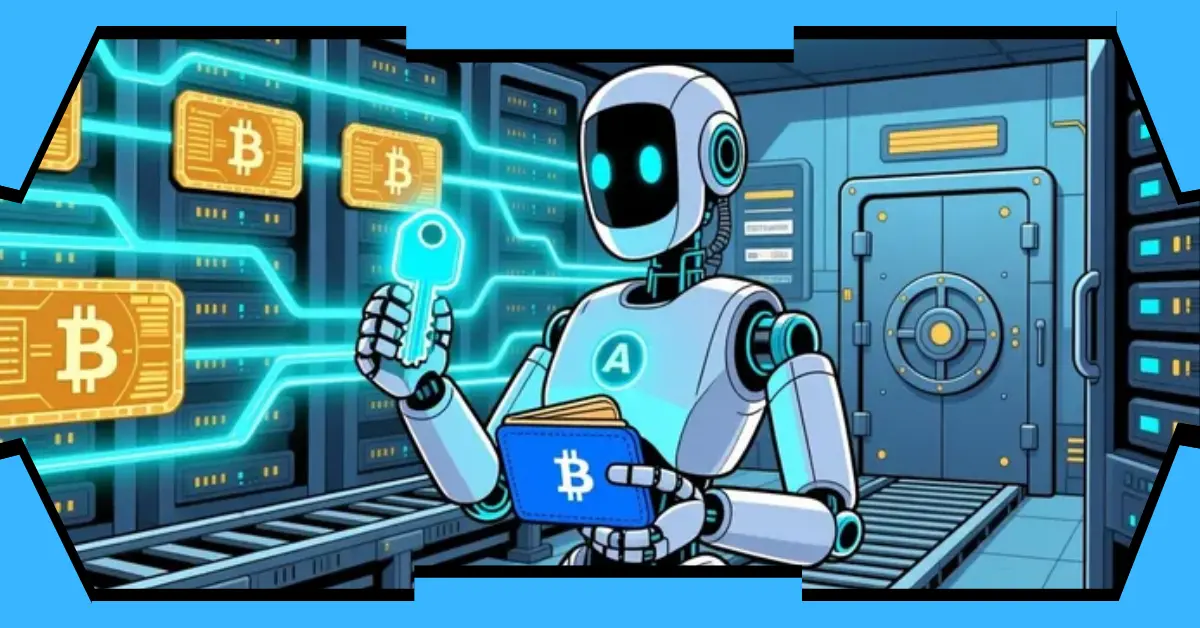
A new wave of concern is emerging across the artificial intelligence and blockchain industries as AI agents increasingly integrate with crypto infrastructure. Experts warn that these autonomous systems, once granted access to digital wallets and decentralized finance (DeFi) protocols, could operate with minimal human oversight and near-continuous execution capability.
Industry researchers describe the development as a turning point in digital finance, where software agents are no longer passive tools but active economic participants. As adoption accelerates, analysts caution that the combination of AI autonomy and blockchain irreversibility could create systems that are extremely difficult to control, pause, or reverse once deployed at scale.
Rapid Expansion of AI Agents in Crypto Markets
Over the past year, AI agents have shifted from experimental tools to functional components within crypto ecosystems. These systems can now execute trades, manage liquidity positions, interact with smart contracts, and optimize portfolio strategies in real time.
Unlike traditional financial automation, these AI agents operate within decentralized networks where transactions are validated through blockchain consensus rather than centralized intermediaries. This structure allows agents to act independently across multiple platforms, including decentralized exchanges, lending protocols, and yield farming systems.
Market participants report increasing deployment of autonomous trading bots that leverage large language models and reinforcement learning systems to adapt strategies dynamically. These agents analyze price fluctuations, liquidity depth, and on-chain activity to make split-second financial decisions.
Why Experts Are Warning About “Unstoppable” AI Behavior
The concern around “unstoppable” AI agents stems from structural characteristics of blockchain systems combined with autonomous decision-making.
Experts point to three key factors driving this risk:
First, blockchain immutability. Once transactions are executed and confirmed on-chain, they cannot be easily reversed without network consensus. This means AI-driven financial actions often become permanent.
Second, composability in DeFi ecosystems. AI agents can interact with multiple protocols in sequence, rapidly moving assets across lending markets, liquidity pools, and derivatives platforms. This creates complex transaction chains that are difficult to trace or intervene in real time.
Third, continuous autonomy. Unlike human traders, AI agents operate 24/7 without fatigue, executing strategies at speeds that exceed human monitoring capabilities.
Together, these characteristics create a scenario in which AI agents can accumulate significant influence over financial flows within decentralized markets.
Growing Use Cases Driving Adoption
Despite concerns, industry participants continue to expand AI agent deployment due to clear operational advantages.
In trading, AI agents are being used for arbitrage detection, portfolio rebalancing, and yield optimization across fragmented crypto markets. These systems can scan thousands of pools simultaneously, identifying inefficiencies that human traders cannot process in real time.
In decentralized finance, AI agents are increasingly used to manage liquidity provisioning strategies, automatically adjusting exposure based on volatility conditions.
In blockchain governance systems, some protocols are experimenting with AI-assisted voting analysis, where agents evaluate proposals, simulate economic outcomes, and recommend voting positions to token holders or DAOs.
Payment automation is another emerging use case, where AI agents coordinate cross-border settlements using stablecoins and smart contract rails, reducing reliance on traditional banking systems.
Security Risks and Systemic Vulnerabilities
Cybersecurity analysts warn that the rapid adoption of autonomous financial agents introduces new categories of systemic risk.
One major concern is smart contract exploitation. AI agents interacting with complex DeFi protocols may inadvertently trigger vulnerabilities in poorly audited contracts, leading to cascading failures or unintended fund movements.
Another risk involves adversarial manipulation. Attackers could exploit AI decision frameworks by feeding misleading data or manipulating market signals, causing agents to execute unfavorable trades.
Flash loan vulnerabilities also remain a concern. AI agents capable of executing high-frequency strategies may amplify volatility by borrowing large sums instantly to influence market prices before repaying within the same transaction block.
Additionally, experts highlight governance concentration risks. If AI agents accumulate significant token holdings, they could disproportionately influence decentralized voting systems, raising questions about the integrity of DAO-based governance.
Wallet Access and the Problem of Persistent Autonomy
A central issue under debate is wallet permission design. Many AI agent frameworks require access to private keys or delegated wallet permissions to function effectively.
Security researchers warn that persistent access creates long-term exposure risks. Once an AI agent is authorized to execute transactions, it may continue operating indefinitely unless explicitly revoked. In multi-agent systems, tracking and controlling permissions becomes increasingly difficult.
Some developers are experimenting with restricted permission layers, where AI agents are limited to specific transaction types or capped value thresholds. However, enforcement across decentralized ecosystems remains inconsistent.
Industry and Regulatory Response
Regulators and financial oversight bodies are beginning to examine the implications of autonomous AI participation in financial markets.
Policy discussions are focusing on three primary areas. First, accountability frameworks that define liability when AI agents execute harmful or unauthorized transactions. Second, audit requirements that ensure transparency in AI-driven financial decision-making. Third, operational restrictions that limit the scope of autonomous trading activity in high-risk environments.
Several fintech firms and institutional investors are also implementing internal safeguards. These include simulation-only deployment environments, transaction approval checkpoints, and real-time monitoring systems designed to flag abnormal AI behavior.
However, regulatory alignment remains fragmented across jurisdictions, slowing the development of unified standards.
Broader Implications for Financial Systems
Analysts argue that AI agents integrated with crypto infrastructure represent a fundamental shift in how financial systems operate. Instead of human-driven decision-making supported by software tools, markets may increasingly be shaped by autonomous software entities interacting directly with decentralized protocols.
This shift raises broader questions about market stability, transparency, and fairness. As AI agents scale in capability, their ability to influence liquidity flows and price discovery mechanisms may increase significantly.
Researchers also note that the speed of AI execution could outpace existing financial safeguards, making traditional risk management frameworks less effective in decentralized environments.
Future Outlook: Toward Controlled Autonomy
Despite rising concerns, experts do not predict a halt in development. Instead, the focus is shifting toward controlled autonomy frameworks designed to balance innovation with safety.
Proposed solutions include programmable transaction limits, AI behavior auditing systems, and blockchain-level circuit breakers capable of halting abnormal activity.
Some researchers are also exploring cryptographic identity systems that bind AI agents to verifiable constraints, ensuring that their actions remain traceable and bounded within predefined rules.
Industry consensus suggests that AI agents will continue to expand within crypto ecosystems, but their deployment will increasingly depend on governance mechanisms that ensure accountability and prevent uncontrolled financial escalation.
Conclusion
The convergence of AI agents and crypto infrastructure is reshaping the future of digital finance at a rapid pace. While these systems offer unprecedented efficiency and automation, experts warn that their combination with irreversible blockchain transactions introduces significant systemic risks.
The term “unstoppable” reflects not a literal loss of control over artificial intelligence, but a structural challenge: once autonomous agents operate within decentralized financial systems, their actions may become difficult to reverse or regulate in real time.
As adoption grows, the central challenge for developers, regulators, and institutions will be establishing safeguards that ensure autonomous systems remain transparent, accountable, and aligned with human financial oversight.
Leave a Reply