Author: admin

  • Navigating Marriage with Life Path Number 33: What it Means in Love and Compatibility.

    Navigating Marriage with Life Path Number 33: What it Means in Love and Compatibility.

    If your numerological chart adds up to 33, then here’s the good news. You aren’t just walking a life path, but you are carrying the light. 

    Life Path Number 33 is the rarest of the Master Numbers, which is known as the ‘Master Teacher.’ In the context of marriage, it signifies a deeply compassionate, self-sacrificing, and committed partner. It isn’t about finding your soulmate, but about a spiritual contract centered on selfless love and nurturing. 

    Want to know what more it says about you, your relationship, and the compatibility? Let’s dive in. 

    The Heart of a 33: What They Bring to the Table

    Being married to a Life Path 33 means being wrapped in warmth and empathy. They are known to prioritize emotional harmony, nurturing, and unconditional love. They shine well together with a generous and attractive spouse. They often find stability with empathetic numbers like 6, 11, 22. 

    However, this high vibration comes with some heavy loads, as they may struggle with perfectionism and stress, making open communication crucial to avoid bottling up emotions.  

    If you are a 33, then you don’t just hear your partner, but you feel their emotions. This extreme empathy creates a deeply supportive environment where your spouse will feel truly seen. You might often feel responsible for your partner’s happiness. While this can be considered a noble thought, in actuality, it can turn into a trap, leading to martyr syndrome if you aren’t careful. 

    A 33 is likely to crave a home that is aesthetically pleasing and peaceful. Since conflicts feel physically draining for you, your demand for creative harmony can turn out to be overwhelming for your partner. 

    You might develop high expectations for your partner, which can also create conflicts. Since you give 120% in your commitment, you are likely to expect the same subconsciously. In case your partner is a bit more self-centered or reserved, this can lead to quiet resentment. 

    Compatibility: Who Can Handle the Master Teacher?

    Handling a Life Path Number 33 is not a piece of cake. Not everyone is equipped with the right tools to balance the intensity of a Master Number. Here’s how the 33 fits with others:

    The Natural Fits (2, 3, 4, 6, and 9)

    Compatibility of 33+2: The Number 2, if paired with 33, has the potential to become a match made in heaven. They will be affectionate and responsible partners once they commit to a serious relationship. However, they both need to work on expressing their feelings openly to avoid conflicts.

    Compatibility of 33+3: The Life Path Number 3 brings fun and communication that keeps a 33 from getting too stuck with the self-sacrificing nature. Although they will be drawn to each other during the initial stages, they might run into conflicts later when open conversations leave the table. 

    Compatibility of 33+4: When Life Path Number 4 joins with 33, they will appear to be a great match, since both share the same values and approach to life. They will be able to take responsibility for each other in a committed relationship. However, 33’s nature of disliking conflicts and confrontation can lead Number 4 to take Number 33’s kindness for granted. 

    Compatibility of 33+6: Since 33 is a higher octave of 6, this pair shares the same home-first values. They are often found to be the most stable pairing, since both have the same approach and perspectives. But the conflicting part will be about who will take the lead, as both love to take the center stage. 

    Compatibility of 33+9: When 33 is paired with a 9, they become the high-voltage couple. They have the potential to achieve incredible things together but require massive amounts of innerwork to stay grounded in order to avoid burnouts. 

    The Challenging Fits (1, 5, 7, and 8)

    Compatibility of 33+1: The pairing of 33 and 1 will be highly challenging as both numbers have the inability to freely and properly express their feelings to each other. 33s do not open up until they are sure about other person’s commitment, while Number 1 is naturally reserved. 

    Compatibility of 33+5: Pairing with 5 will be difficult for Number 33 after the initial stage, since the Number 5’s unrestrained, restless, and unpredictable nature will overwhelm 33, who is home-oriented and values stability, validation, and commitment.

    Compatibility of 33+7: The pairing of 33 and 7 is unlikely to happen since they cannot even be found in the same social circle. Since Number 33s like someone who stands out in the crowd, they are not going to notice Number 7, who is too shy and withdrawn in nature. Number 7 also might not notice Number 33s or might even get suspicious of their perfect nature. 

    Compatibility of 33+8: The challenge for the pairing of 33 and 8 is their shyness to make the first move. Since both are cautious and waits for assurance from the other person to express their feelings, they are most likely to miss opportunities to connect with each other, thinking the other person might not be interested. But once connected they will be a great couple. 

    The Master Connections (11, 22, and 33)

    Compatibility of 33+11: The Numbers 33 and 11 will be a great pair and will be like a match made in heaven. But they need to work on their communication for a healthy relationship. Instead of bottling up feelings they need to learn to express them in a constructive way. 

    Compatibility of 33+22: The pair of 33 and 22 will work greatly together since both share the same values, interests, and approach to life. This pair will not be filled with great passion but they will be stable and practical without any huge emotional outbursts. 

    Compatibility of 33+33: The pairing of 33 and 33 will be great since both have the same energy and approach to life. They will be able to understand each other easily and take responsibility together. But the conflict will arise when both want to be the leader. It can create jealousy and resentments. 

    How to Navigate the Marriage with Number 33

    If you are a 33 or have a partner who is 33, then remember to set some ground rules for a healthy marriage. 

    First of all, you need to set emotional boundaries. 33 must understand that understanding their partner’s mood and fixing it is not their project. They must also lean to ask for help. Although 33s do not like to look weak, give your spouse the chance to lead since they too need to feel needed. 

    Since the marriage can have a path of seriousness, make sure you have playful moments and fun nights where you both just relax and enjoy the moment together. 

    An important pillar of your relationship will be honest communication. Practice it rather than running away from conflicts. Instead of keeping quiet to keep the peace, try to resolve the conflicts with healthy conversations. 

    In numerology, the Number 33 represents the evolution of love. In relationship this signifies the transformative phase that is essential and inevitable for a long-lasting and healthy marriage.
  • What is the Meaning of Empty Houses in Astrology: What are They Hiding?

    What is the Meaning of Empty Houses in Astrology: What are They Hiding?

    Have you ever pulled out your birth chart and felt that shudder as you saw some of your houses were completely empty? Well, then take a deep breath. You are not missing a personality, and your life isn’t a blank in those areas. 

    In the realm of astrology, there are 12 houses, but there are only 10 primary celestial bodies. So, of course, you’ll have an empty house. But it’s not completely empty as you think. 

    Here is the breakdown of the ‘empty houses’ and how to read the invisible energy living inside them. 

    Breaking the Big Myth: An Empty House Doesn’t Equal a Boring Life

    Many people become anxious when they see empty houses in their birth chart. When they see an empty 7th House (relationships) or 10th House (Career), they fear that they’ll never marry or find success in life. But that is not how the cosmic clock works. 

    A Full House represents an area of life that is involved in a lot of activities, noise, and perhaps a bit of a complex life lesson. This is where you will be forced to focus your attention. 

    But an empty house in astrology, or a house with no planets at birth, simply means there is less focus of the energy, emotions, and Karmic influences. It does not signify a lack of experience, a misfortune, or a failure, but rather a neutral zone that requires less intense efforts. 

    An empty house suggests an area of life that feels more natural or straightforward. It is not a void. It is just not the primary focal points for your soul’s evolution in this lifetime. You might find these areas of life work out on their own without any hard work or great realizations. The house will still be active, governed by its ruling planet. 

    How to Read an Empty House?

    Just because the house is not occupied by anyone, it doesn’t mean the house is abandoned. Since every house is ruled by a specific zodiac sign based on your rising sign (ascendant), you must primarily look at its House Lord to understand the empty house. 

    Step 1: The first step is to identify the sign. You need to look at the cusp or the starting line of the empty house for that. 

    Step 2: The next step is to find the ruler. Every sign is associated with a planetary ruler (e.g., if your empty house is in Taurus, the ruler will be Venus). 

    Step 3: The third and last step is to locate that planet. If the ruler is Venus, then where is Venus in your chart? That planet acts as the landlord, managing all the affairs of the empty house from another house. 

    What Does it Mean for Each House When it is Empty?

    If you are seeing emptiness in certain areas in your birth chart, here is the quick roadmap to identify what that emptiness usually indicates:

    An Empty 1st House (Self/Identity): You likely possess a stable sense of self, which doesn’t require constant reinvention. Your self-awareness develops naturally without any external or internal, intense pressure. 

    An Empty 2nd House (Money/Values): Finance might not be your primary concern or obsession. It won’t be a matter of constant or immediate stress for you. You likely have a ‘work to live’ than a ‘live to work’ mentality.

    An Empty 3rd House (Communication): Learning and daily interactions feel easy for you. You don’t feel the need for any hard work or heavy lifting in terms of communication. 

    An Empty 4th House (Home/Family): You have a peaceful and less complex upbringing or domestic life. Your private life and roots are likely a smooth ride rather than a source of constant friction that forces intense focus. 

    An Empty 5th House (Creativity/Romance): Joy and hobbies come to you naturally when you want them, without feeling the desperation or urge to perform. Creativity and romance feel pleasurable to you, rather than feeling dramatic. 

    An Empty 6th House (Health/Routine): Your health and work habits are easily managed. Although you are not an overly health-conscious individual who meticulously analyses their body and follows diets accordingly, you don’t constantly face health crises. 

    An Empty 7th House (Partnerships): You aren’t destined to be alone. The emptiness often means that relationships are not the central challenge or drama in your life. It is not your only source of growth, and you will find yourself through other means. 

    An Empty 8th House (Transformation/Intimacy): You feel less conflict around intimacy and change. You might prefer a smoother emotional path and avoid the dark period of your soul, which often takes away the focus of others. 

    An Empty 9th House (Philosophy/Travel): Even though your philosophical growth occurs, it is not your main path. Your belief systems might have settled early. Hence, you don’t feel the constant friction and existential crisis as you face corruption within a system. 

    An Empty 10th House (Public Image): You can still have a massive career. It is just that it won’t be the only or primary thing that defines your identity. You can achieve career success steadily without any obsessive striving. 

    An Empty 11th House (Social Circles): Social networking will be easy for you. You likely have low drama with your friends and don’t feel the urge to lead every group you join. 

    An Empty 12th House (Spirituality/Subconscious): You have an easy relationship with spirituality and fewer inner conflicts. Your inner demons are quiet, or your spiritual path is a private, peaceful affair rather than a public struggle. 

    Conclusion

    An empty house doesn’t stay empty forever. Since planets are constantly moving, when a transit planet (like Jupiter or Saturn) moves through your empty house, it’s like a guest who stays in your spare room for a period of time. During this time, that quiet area of your life might suddenly take the main character’s energy. This transit can be used to renovate that part of your life. 

    An empty house is your room to breathe. It’s an area where you won’t feel the burden of expectations, hard work, constant hurdles, and other external pressures. See those houses as the room for you to relax, not as the missing pieces. 

  • A Deep Dive into Master Numbers 11, 22, 33: Exploring the Hidden Power

    A Deep Dive into Master Numbers 11, 22, 33: Exploring the Hidden Power

    Doesn’t it feel special when you look at your watch, and it shows exactly 11:11, or when you notice that it is exactly $22.22 on your grocery bill? Have you ever spotted a repetition in patterns of 11, 22, or 33 in the number plates, phone numbers, or house numbers that randomly attracts your attention? 

    It can make you feel surprised and excited, but if you are about to throw it away as a mere coincidence, you should know this. There is nothing coincidental about this. 

    In numerology, while most digits are reduced to a single number (e.g., 12 becomes 3), three specific numbers are kept whole because they carry a powerful spiritual frequency with higher purposes. 

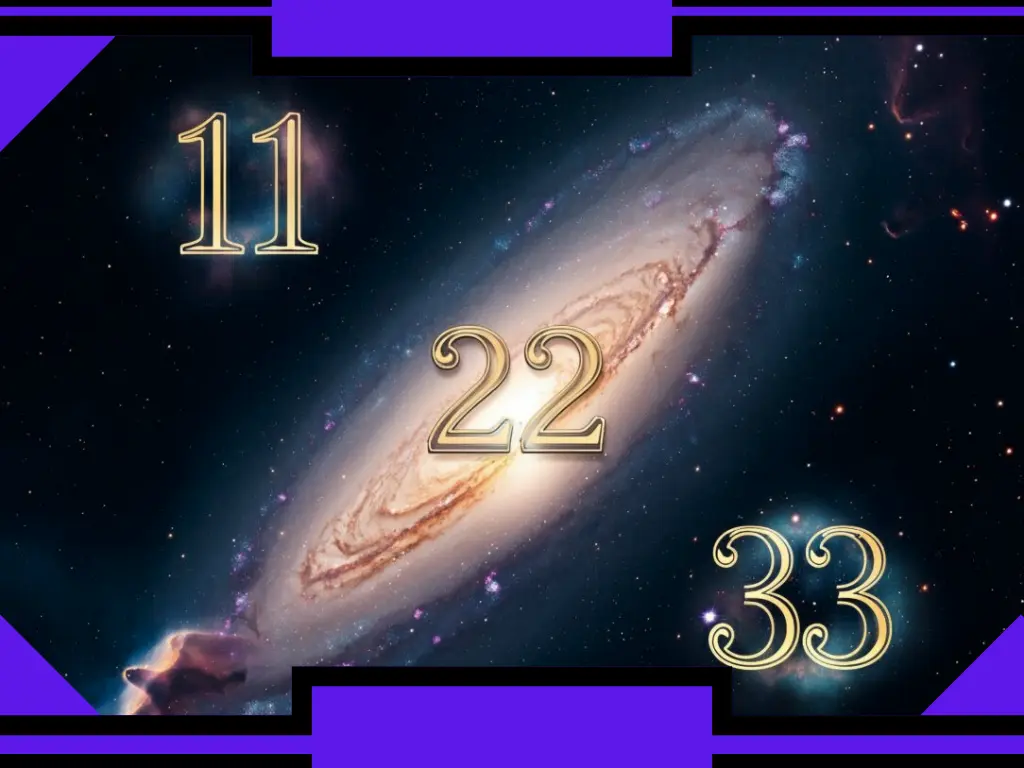
    11, 22, 33 – these are called the Master Numbers. They are the supercharged versions of the single numbers they can be reduced to. They bring you a greater potential for success, but also a higher set of challenges along with it. 

    Let’s take a deeper look at this Triangle of Enlightenment and what makes these numbers highly significant. 

    Number 11: The Master Messenger

    The first of the Master Numbers, the 11, acts as the bridge between the conscious and the subconscious. The number reduces to 2 (1+1=2), but it radiates raw, high-energy intuition, which bypasses the usual quiet diplomacy of 2. 

    The 11 is a psychic number. People who have 11 in their chart often display high sensitivity, an intuitive nature, and slight anxiety, as they can pick up on things that others might easily miss. Their primary quality is their unmatched insight, making their purpose here is to be a visionary or a messenger who brings new ideas to the world. 

    But there is a shadow side to this Master Number. Because of its high sensitivity, the Number 11 can suffer from indecision or analysis paralysis, where they overanalyze things and end up taking no action. 

    If they don’t learn to trust their gut, they will end up feeling overwhelmed by the same high-level energy, which can be their superpower. Only by owning their strength and sharing their inner light with others can they overcome their fear and move forward in life.  

    Number 22: The Master Builder

    While Number 11 is a dreamer who brings a vision to the world, the Number 22 is the architect who actually builds it. Reduced to 4 (2+2=4), the Number 22 multiplies the stability and hard-working nature of the 4 with the cosmic proportions and reflects the ultimate master builder energy. 

    Being arguably the most powerful number in numerology, it has the unique ability to turn big, impossible dreams into physical reality. 

    The practical brilliance is its highest strength. The Number 22 is expert at organizing people, resources, and timelines to create something that lasts for generations, like massive corporations, movements, or even cities. 

    The darker side of this high potential is the immense pressure. Since the Number 22 is capable of so much, those under its influence often feel a crushing sense of not doing enough. If they lose their way, they can become dictatorial or overly focused on material gains. 

    The key purpose of those with the Number 22 in their chart is to use their leadership skills to build things that will ultimately benefit humanity and inspire people to walk towards goodness, rather than filling their own pockets.  

    Number 33: The Master Teacher

    The Number 33 is the rarest and the most enlightened among the trio. It is the most spiritually evolved Master Number. Reduced to 6 (3+3=6), the number of nurturers and home-oriented ones, the 33s possess that parental energy, which they apply to the entire world. 

    Being defined by the characteristic traits like unconditional love and selfless service, the Number 33 is often called the Master Teacher or Master of Healing. 

    The emotional intelligence of Number 33 will be very high. They won’t have any personal agenda, but rather focus on the spiritual upliftment of others. They will lead through kindness and creative expressions. 

    But one serious challenge regarding the Number 33 is their martyr complex. Because they want to save everyone, they are willing to give their 200% for a commitment. But this can make them totally exhausted. 

    As they end up taking too many responsibilities, emotional fatigue, and holding unrealistic expectations, they can either burn out or become highly preachy and judgmental if others don’t live up to their expectations and moral standards. 

    The goal of Number 33 is to bring compassion to the world. They are supposed to show the world how to be kind and teach through the example of themselves, but without losing personal boundaries. 

    Why Do These Numbers Matter?

    Having a Master Number in the chart is like being given a high-performance vehicle. It will be faster and more capable than the normal ones, but it requires more maintenance and will be harder to handle. 

    The Master Numbers represent a more challenging, yet rewarding, life path. They indicate high expectations, which can lead to high pressure or a heavy flow of energy in the chart. 

    There are two things to remember for those who have a Master Number in their chart. 

    The first thing is about the burden of potential. You need to remember that you are not better than anyone for having these numbers. But rather, you have a bit more complex set of lessons to learn and execute in life. 

    The next thing is the importance of timing. Most people don’t fully unlock their Master Number energy until later in their lives. They are able to fully access it only when they have gained enough maturity to handle its intensity. 

    So, if you are an 11, 22, or 33, stop playing small and be ready for the big things. You are wired for great things, and it’s time to start tapping into your true strength. 

  • The Psychology Behind High-Converting Marketing Campaigns

    Understanding the Invisible Forces of Consumer Choice

    Have you ever wondered why you feel an irresistible urge to buy a product after seeing a single social media ad, while other brands struggle to get a second glance? The difference rarely lies in the budget alone. Instead, it’s found in the deep, often subconscious triggers that drive human behavior. High-converting marketing isn’t just about flashy graphics; it is about mastering the psychological nuances that guide our decision-making processes.

    To build a campaign that resonates, marketers must look beyond demographics and dive into psychographics. By understanding how the human brain processes information, assesses value, and responds to social cues, brands can create experiences that feel less like a sales pitch and more like a solution. In this article, we explore the core psychological principles that separate mediocre ads from viral, high-converting masterpieces.

    The Power of Cognitive Biases in Advertising

    At the heart of every successful campaign is an understanding of how the brain shortcuts complex decisions. These mental shortcuts, known as cognitive biases, allow us to make fast judgments in an information-heavy world. When marketers align their messaging with these natural inclinations, they reduce “cognitive friction,” making it much easier for a customer to say “yes.”

    The Scarcity Principle and Urgency

    One of the most potent tools in a marketer’s arsenal is the concept of scarcity. When we perceive that an item is in short supply or available for a limited time, our brain triggers a “loss aversion” response. We are naturally more motivated to avoid losing an opportunity than we are to gain a new one. This is why phrases like “Only 3 left in stock” or “Offer expires at midnight” are so effective.

    This tactic works because it bypasses the analytical mind and speaks directly to our primal instincts. However, for scarcity to drive high conversions, it must be perceived as authentic. If a “one-day sale” lasts for three weeks, the psychological tension evaporates, and the brand loses the most valuable asset in marketing: consumer trust.

    Social Proof and the Bandwagon Effect

    Humans are inherently social creatures. When we are uncertain about a decision, we look to the behavior of others to determine the “correct” path. This is known as social influence, a psychological phenomenon where people mirror the actions of others in an attempt to reflect correct behavior for a given situation.

    In marketing, this manifests as user reviews, testimonials, influencer endorsements, and “Best Seller” badges. By showcasing that thousands of others have already taken the leap, a brand lowers the perceived risk for the new customer. High-converting campaigns don’t just tell you a product is good; they show you a community of satisfied people who agree.

    Emotional Triggers: Moving Beyond Logic

    While we like to think of ourselves as rational beings, the reality is that we make most of our purchasing decisions based on emotion and then justify them with logic afterward. A campaign that fails to spark an emotional connection—whether it’s joy, fear of missing out, or a sense of belonging—will likely struggle to convert.

    The Role of Emotional Resonance

    High-converting campaigns often tap into “The Why.” Instead of listing features, they sell a transformation. For example, a high-end watch company isn’t selling a tool to tell time; they are selling status, legacy, and craftsmanship. By identifying the core emotional need of their audience, brands can craft narratives that bypass the skeptical “logical” brain and head straight for the heart.

    Using storytelling is one of the most effective ways to build this resonance. A story creates a mental simulation for the consumer, allowing them to visualize themselves using the product and experiencing the positive outcome. This narrative transport makes the brand more memorable and the call to action more compelling.

    The Contrast Principle in Value Perception

    How we perceive the price of a product is entirely relative. This is where the cognitive bias of anchoring comes into play. If you see a jacket priced at $500 followed by one priced at $150, the second jacket seems like a bargain, even if its objective value is lower.

    Marketers use this by presenting a “premium” option first to set a high anchor, making the standard options feel more accessible. This psychological framing ensures that the consumer feels they are making a “smart” financial choice, satisfying the logical side of the brain while the emotional side enjoys the new purchase.

    The Neuromarketing Advantage: Science-Backed Strategy

    As technology evolves, marketers are increasingly turning to neuroscience to understand how the brain reacts to specific stimuli. Neuromarketing uses tools like eye-tracking and fMRI to see which colors, fonts, and layouts trigger the most positive neural responses.

    Leveraging the Primacy and Recency Effects

    The human brain is wired to remember the beginning and the end of an experience more vividly than the middle. In a marketing campaign, this means your “hook” and your “call to action” (CTA) are the two most critical components. If the opening of your video or the headline of your landing page doesn’t grab attention immediately, the rest of the content—no matter how good—is wasted.

    Similarly, the final impression must be strong. A clear, authoritative, and rewarding CTA provides the closure the brain seeks. High-converting campaigns ensure that the message is consistent from the first second to the last, reinforcing the brand’s core value proposition at every touchpoint.

    Limitations and Ethical Considerations

    While psychological triggers are incredibly effective, they come with a “saturation point.” Modern consumers are more savvy than ever. If a campaign relies too heavily on “dark patterns” or manipulative psychology, it can lead to brand fatigue or even a backlash.

    The challenge for modern marketers is to use these insights ethically. The goal should be to help the user find the right solution for their needs faster, not to trick them into a purchase they will later regret. Over-using urgency or fake social proof can lead to high initial sales but will ultimately destroy long-term customer lifetime value.

    Comparison: Rational vs. Emotional Marketing Models

    To truly master the psychology of conversion, one must understand the balance between the “System 1” (fast, instinctive, emotional) and “System 2” (slow, deliberate, logical) thinking processes described by psychologists.

    FeatureEmotional Marketing (System 1)Rational Marketing (System 2)
    Primary DriverFeelings and IntuitionData and Features
    Speed of ActionImmediate / ImpulseDeliberate / Research-heavy
    Best ForB2C, Fashion, Impulse buysB2B, Software, High-cost investments
    Key ElementStorytelling and ImagerySpecifications and ROI

    The most successful campaigns—the “unicorns” of the marketing world—actually blend these two. They use an emotional hook to grab attention (System 1) and then provide enough data and logical reasoning (System 2) to give the customer “permission” to buy.

    The Future of Psychological Marketing

    As we move further into the era of personalization, the psychology behind marketing will become even more granular. With the help of decision theory, brands are now able to predict consumer behavior patterns with startling accuracy. We are seeing a shift from mass marketing to “me marketing,” where the psychological triggers used are tailored to an individual’s specific personality traits and past behaviors.

    This level of precision requires a deep commitment to data privacy and transparency. The brands that win in the coming decade will be those that use psychology to build genuine connections and simplify the customer journey, rather than those that use it to create artificial pressure.

    Conclusion: Mastering the Mind to Capture the Market

    The psychology behind high-converting marketing campaigns is a blend of art and science. It requires a deep empathy for the consumer’s pain points, an understanding of their subconscious biases, and the technical skill to deliver the right message at the right time. By integrating principles like scarcity, social proof, and emotional resonance, you move beyond “selling” and start “connecting.”

    Ultimately, a high-converting campaign is one that respects the human brain’s desire for simplicity, belonging, and value. When you align your brand’s goals with the natural psychological pathways of your audience, conversion becomes a natural byproduct of a well-formed relationship. Focus on the human element, and the numbers will inevitably follow.

  • Modern Marketing Strategies That Actually Work in 2026

    Modern Marketing Strategies That Actually Work in 2026

    The marketing landscape of 2026 is no longer defined by who can shout the loudest, but by who can listen the most intently. We have officially moved past the era of mass-marketed noise and entered an age where precision, ethics, and human connection dictate the bottom line. With the rapid evolution of artificial intelligence and shifting consumer priorities, the “tried and true” methods of even two years ago are quickly becoming relics.

    Today, consumers are digitally fatigued and highly skeptical of automated interactions. They aren’t just looking for products; they are looking for brands that align with their values and respect their time. To succeed in this environment, marketers must balance high-tech efficiency with a high-touch human element. This article explores the core strategies that are driving real growth and engagement in 2026.

    The Rise of Hyper-Personalization and Predictive Analytics

    Personalization has evolved from a “nice-to-have” feature into a baseline expectation. In 2026, simply putting a customer’s first name in an email subject line is considered the bare minimum. True modern marketing relies on hyper-personalization, which uses real-time data to anticipate a user’s needs before they even express them.

    Real-Time Behavioral Integration

    The most successful brands today are moving beyond static customer profiles. Instead, they leverage generative engine optimization to ensure their content is not only visible to humans but also easily interpreted by the AI assistants that many consumers now use as gatekeepers for their purchasing decisions.

    By integrating cross-channel data—from smart home interactions to mobile browsing patterns—companies can deliver “just-in-time” offers. For example, a grocery brand might send a discount for oat milk exactly three days before their data predicts the customer will run out, delivered via a push notification when the user is geographically near a retail partner.

    Insights from AI-Driven Predictive Modeling

    Predictive analytics has shifted from guessing what might happen to modeling specific outcomes with startling accuracy. Marketers are using these insights to:

    • Reduce Churn: Identifying “at-risk” behaviors and deploying automated, empathetic retention campaigns.
    • Dynamic Pricing: Adjusting costs in real-time based on demand, supply, and individual loyalty segments.
    • Content Tailoring: Using AI to rewrite website copy on the fly to match the reading level and tone preference of the specific visitor

    Influencer Marketing 2.0: The Community-First Approach

    The “celebrity influencer” era has largely cooled off, replaced by a much more potent force: the niche community leader. In 2026, reach is secondary to resonance. Brands are no longer chasing millions of followers; they are chasing thousands of deeply engaged fans.

    The Power of Micro and Nano-Influencers

    Data shows that nano-influencers—those with fewer than 10,000 followers—often boast engagement rates five to ten times higher than traditional celebrities. These creators act as “peers” rather than “idols.” When they recommend a product, it feels like a suggestion from a trusted friend. This shift is crucial because modern consumers have developed a biological “ad blindness” to polished, high-budget commercial content.

    Advantages of Long-Term Creator Partnerships

    Short-term, one-off sponsored posts are dying out. The strategies that actually work in 2026 involve multi-month or multi-year “ambassadorships.”

    • Authenticity: Over time, the creator’s audience sees the product integrated into their real life, building genuine trust.
    • Co-Creation: Brands are increasingly allowing influencers to help design products, ensuring the final result is something the community actually wants.
    • Lower Acquisition Costs: Repeat exposure through a trusted voice reduces the friction of the initial purchase, leading to a higher return on investment (ROI).

    Limitations and Challenges of the Creator Economy

    While powerful, this strategy isn’t without its hurdles. The biggest challenge in 2026 is attribution. As consumers move through a fragmented journey across TikTok, private Discord servers, and AI search engines, it becomes difficult to pinpoint exactly which influencer interaction led to a sale.

    Furthermore, there is the risk of “brand-creator misalignment.” If an influencer is involved in a controversy, the brand is immediately in the line of fire. Managing dozens of small-scale relationships also requires significantly more manual oversight and coordination than managing one large agency contract.

    Immersive Tech and the “Return of Touch”

    Paradoxically, as our lives become more digital, we are seeing a massive resurgence in the value of physical and sensory experiences. This is often referred to in the industry as the “Return of Touch.”

    Augmented Reality (AR) as a Conversion Tool

    AR is no longer a gimmick; it is a vital part of the e-commerce funnel. Consumers in 2026 use AR to “place” furniture in their homes, “wear” makeup via their smartphone cameras, and even preview how a new car would look in their driveway. This reduces the “certainty gap” that often leads to cart abandonment and high return rates.

    The Evolution of Experiential Retail

    Physical stores are being reinvented as “galleries” or “experience centers.” They aren’t meant for stocking thousands of items; they are meant for building brand affinity. We see this in the rise of retail tourism, where customers visit a store for a sensory-rich activation—such as a VR journey through a brand’s sustainable supply chain—and then complete their purchase digitally later.

    Analysis: Human-Centricity vs. Pure Automation

    When we compare the most successful strategies of 2026, a clear pattern emerges. The brands winning the market are those that use automation to handle the mechanics of marketing but keep humans in charge of the meaning.

    FeatureAutomated Strategy (Standard)Human-Centric Strategy (2026 Best Practice)
    Customer SupportScripted AI ChatbotsAI-Empowered Humans with Empathy
    Content GrowthMass-produced AI SEO blogsExpert-led, original cognitive bias-informed storytelling
    Data UsageThird-party tracking (Cookies)First-party data through value-exchange
    Success MetricClick-Through Rate (CTR)Customer Lifetime Value (CLV) & Trust

    The analysis suggests that while AI can optimize a campaign, it cannot build a brand. Purely automated brands are finding themselves in a “race to the bottom” on price, while those investing in community and original thought-leadership are maintaining premium margins.

    Conclusion

    The modern marketing strategies that actually work in 2026 are those that respect the intelligence and the humanity of the consumer. We have moved from a transactional mindset to a relational one. Whether it is through the precision of predictive analytics, the intimacy of micro-influencer partnerships, or the immersive power of AR, the goal remains the same: to be helpful, relevant, and authentic.

    Success in this era requires a delicate balance. You must embrace the cutting-edge tools of AI and data science to remain competitive, but you must never lose sight of the fact that behind every data point is a human being looking for a solution, a connection, or an experience. Those who can bridge the gap between the digital and the physical—and the automated and the emotional—will be the ones leading the market for the rest of the decade.