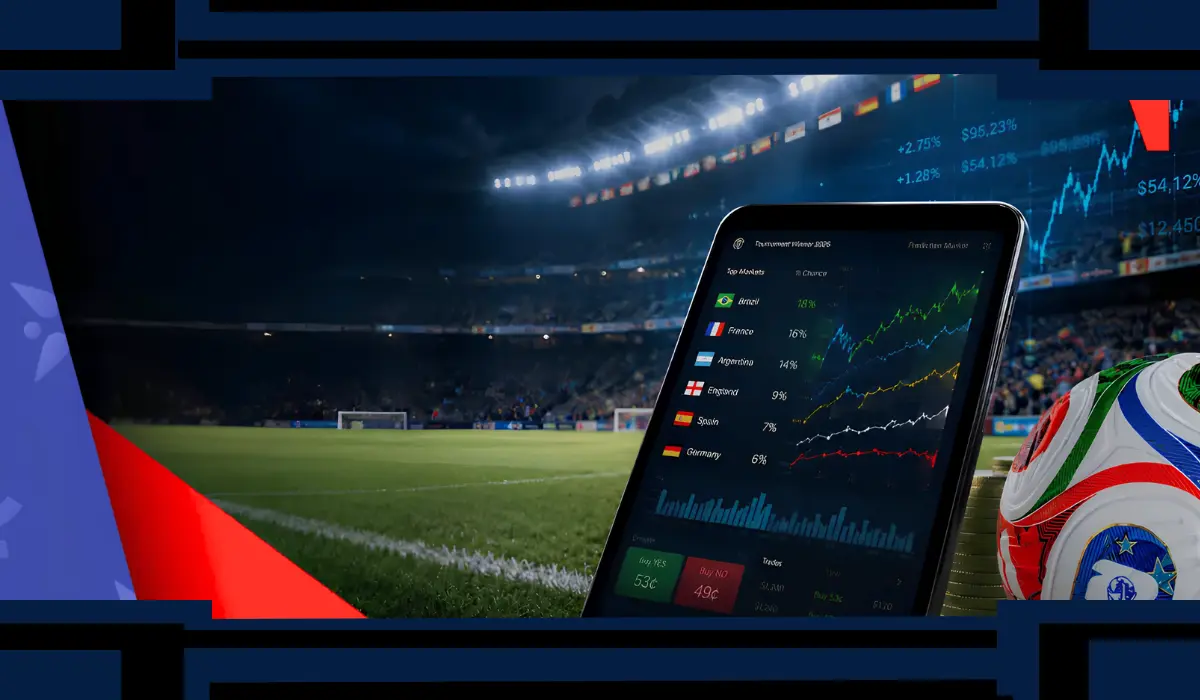
Polymarket has become one of the biggest talking points in the growing intersection between cryptocurrency and global sports as the 2026 FIFA World Cup reaches its semifinal stage. The prediction market platform is experiencing increased attention from traders and football fans who are using blockchain-based contracts to forecast match outcomes, tournament winners, and other major events.
As the World Cup semifinals approach, interest in Polymarket’s sports markets has accelerated. The platform allows users to trade on future outcomes instead of relying only on traditional betting formats. Consequently, every major update, including team form, injuries, tactical changes, and match results, can influence market prices in real time.
The growing activity highlights a broader shift in digital finance. Crypto-powered prediction markets are becoming a new way for users to analyze global events, while major sporting competitions are providing a powerful opportunity for blockchain platforms to reach mainstream audiences.
Polymarket Gains Attention During World Cup Semifinals
The final stages of the FIFA World Cup have created strong demand for prediction markets. With only four teams remaining, traders are closely monitoring championship probabilities and semifinal match expectations.
The semifinal lineup features high-profile clashes, including France facing Spain and England meeting Argentina. These matches have attracted global attention because of the teams’ histories, star players, and potential impact on the tournament outcome.
Polymarket’s model works differently from traditional sportsbooks. Instead of offering fixed betting odds, the platform operates through market-based pricing. Users buy and sell shares connected to possible outcomes, and the price reflects the collective expectation of participants.
For example, when a contract trades at a certain value, the market is effectively estimating the probability of that event happening. As new information becomes available, traders can adjust their positions.
This approach has attracted crypto users who are already familiar with financial markets. They view prediction contracts as another form of market analysis where sentiment, data, and probability influence price movements.
Crypto and Sports Partnerships Accelerate Digital Adoption
The rise of Polymarket comes during a period when cryptocurrency companies are expanding their presence in global sports. Major sporting events have become important platforms for blockchain businesses seeking mainstream visibility.
The World Cup, with billions of viewers worldwide, represents one of the largest opportunities for digital asset companies. Crypto firms are increasingly exploring partnerships, sponsorships, and fan engagement solutions connected to major tournaments.
Meanwhile, prediction markets benefit from this growing ecosystem because they combine two major interests: sports entertainment and financial technology.
The connection between crypto and sports is also evolving beyond simple sponsorships. Blockchain technology is being used for digital payments, fan experiences, collectibles, and decentralized applications.
As a result, platforms like Polymarket are gaining attention because they demonstrate how blockchain systems can create new forms of participation around global events.
Why World Cup Trading Activity Is Increasing
Several factors are contributing to the increased activity around World Cup prediction markets.
First, the knockout stage creates higher engagement because every match directly affects the tournament outcome. Unlike early group-stage games, semifinal results determine which teams reach the final, making predictions more valuable to fans and traders.
Second, prediction markets provide continuous price updates. A goal, injury, lineup announcement, or tactical adjustment can immediately change market expectations.
Additionally, social media discussions are increasing awareness. Crypto communities, football analysts, and data-driven traders are sharing predictions and market movements, bringing more attention to platforms such as Polymarket.
The platform’s appeal also comes from transparency. Users can observe market movements and understand how thousands of participants are evaluating an event. This creates a different experience compared with traditional prediction methods based only on expert opinions.
How Polymarket Differs From Traditional Betting Platforms
Polymarket represents a different approach to sports forecasting. Traditional betting platforms generally provide predetermined odds, while prediction markets rely on user-driven pricing.
This difference allows participants to trade positions before an event concludes. A trader who changes their opinion about a team’s chances can potentially exit a position instead of waiting until the final result.
Furthermore, prediction markets create a public record of collective expectations. The changing price of a contract reflects how participants respond to new information.
However, the model also comes with challenges. Market liquidity, regulatory requirements, and user protection remain important issues for prediction platforms.
Because these platforms involve financial transactions connected to real-world outcomes, regulators continue to examine how prediction markets should operate. Therefore, future growth will depend on balancing innovation with responsible market practices.
Polymarket’s Role in the Future of Crypto-Based Forecasting
The World Cup surge demonstrates the wider potential of prediction markets beyond sports. While football has become a major driver of user interest, the technology can be applied to many areas.
Prediction markets can cover topics such as economic trends, technology developments, entertainment events, and other global issues. By allowing users to trade on future possibilities, these platforms create a market-based approach to forecasting.
Moreover, the growth of artificial intelligence and data analytics could further improve prediction accuracy. Traders may increasingly combine historical performance, statistical models, and real-time information to make decisions.
For the crypto industry, prediction markets represent another example of blockchain moving beyond digital assets. Instead of focusing only on cryptocurrencies, blockchain technology is becoming part of broader digital experiences.
The World Cup has provided a major test case for this transformation. Millions of fans are discovering new ways to engage with football through technology-driven platforms.
Challenges Facing Crypto Prediction Markets
Despite the rapid growth, prediction markets still face several obstacles.
Regulation remains one of the biggest challenges. Different countries have different approaches toward digital asset platforms and event-based trading. As adoption increases, companies will need to navigate complex legal environments.
Security and user education are also important factors. New participants must understand that prediction markets involve financial risk and that market prices do not guarantee accurate outcomes.
Additionally, competition is increasing. Traditional betting companies, financial technology firms, and emerging blockchain platforms are all exploring ways to combine entertainment with digital finance.
Therefore, long-term success will depend on trust, transparency, and the ability to provide a reliable user experience.
Conclusion
Polymarket’s growing World Cup semifinals activity highlights the changing relationship between cryptocurrency, sports, and digital markets. The platform has transformed football predictions into a dynamic trading experience where users analyze probabilities and respond to real-time developments.
As crypto adoption expands, major sporting events like the FIFA World Cup are becoming important testing grounds for blockchain-powered applications. Prediction markets demonstrate how technology can create new forms of fan engagement while introducing financial concepts to a global audience.
Although regulatory and operational challenges remain, the momentum behind Polymarket shows that crypto-based forecasting platforms are becoming a significant part of the evolving digital economy. The World Cup semifinals have not only created excitement on the pitch but have also accelerated the growth of a new generation of prediction-driven markets.
Leave a Reply